AutoML: Democratizing Machine Learning for Businesses
Machine learning has long been seen as a powerful yet complex capability—one that requires deep expertise in statistics, programming, and data engineering. For years, only highly skilled data scientists could build, train, and deploy machine learning models effectively. However, this is rapidly changing with the rise of Automated Machine Learning, or AutoML.
AutoML is transforming how organisations adopt artificial intelligence by simplifying and automating many of the technical steps involved in building machine learning models. In doing so, it is opening the door for a much wider range of users—including business analysts, developers, and non-technical professionals—to leverage machine learning in practical, impactful ways.
The Complexity Barrier in Traditional Machine Learning
To understand the significance of AutoML, it is important to consider the traditional machine learning workflow. Building a model typically involves multiple stages: data preparation, feature engineering, model selection, hyperparameter tuning, evaluation, and deployment. Each of these steps requires specialised knowledge and can be time-consuming.
For many businesses, especially small and medium-sized enterprises, this complexity has been a major barrier to adoption. Hiring skilled data scientists is expensive, and developing in-house expertise can take years. As a result, many organisations have struggled to move beyond pilot projects and fully integrate machine learning into their operations.
What AutoML Brings to the Table
AutoML addresses these challenges by automating key parts of the machine learning lifecycle. Instead of manually selecting algorithms or tuning parameters, users can rely on AutoML systems to handle these tasks automatically.
At its core, AutoML platforms can:
- Clean and preprocess data
- Generate and select relevant features
- Train multiple models and compare their performance
- Optimize hyperparameters
- Deploy the best-performing model
This automation significantly reduces the time and effort required to build effective models. What once took weeks or months can now be accomplished in hours or even minutes.
Lowering the Barrier to Entry
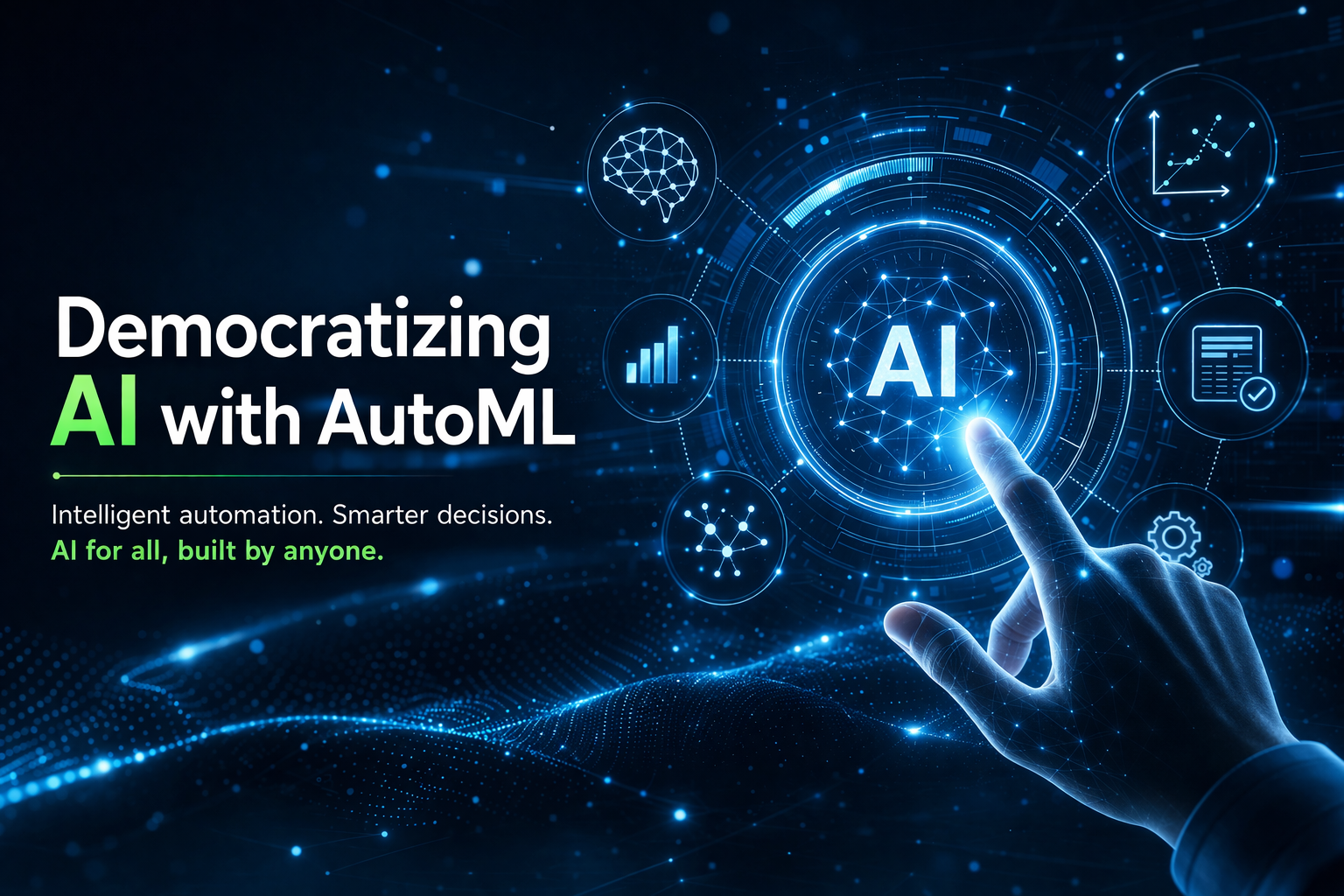
One of the most important impacts of AutoML is its ability to democratize machine learning. By simplifying complex processes, it enables a broader audience to participate in data-driven innovation.
Business users can now experiment with machine learning models without needing to write extensive code. Many AutoML platforms offer intuitive, drag-and-drop interfaces or natural language capabilities, making them accessible to non-technical users.
This shift is particularly valuable in organisations where domain experts—such as marketers, financial analysts, or operations managers—have deep knowledge of business problems but limited technical skills. With AutoML, these users can directly apply machine learning to their specific use cases, bridging the gap between business needs and technical implementation.
Accelerating Time to Value
Speed is another key advantage of AutoML. In competitive industries, the ability to quickly test ideas and deploy solutions can be a significant differentiator.
AutoML enables rapid prototyping, allowing organisations to explore multiple models and approaches in a short period of time. This iterative process helps identify the most effective solutions faster, reducing the time to value.
For example, a retail company can use AutoML to quickly build a demand forecasting model, while a financial institution can develop fraud detection systems without extensive development cycles. This agility is critical in today’s fast-paced business environment.
Enhancing Productivity for Data Teams
While AutoML is often associated with non-technical users, it also benefits experienced data scientists and engineers. By automating repetitive tasks such as hyperparameter tuning and model selection, AutoML allows experts to focus on more complex and strategic aspects of their work.
Instead of spending time on routine processes, data professionals can concentrate on problem formulation, data quality, and interpreting results. This not only improves productivity but also enhances the overall quality of machine learning initiatives.
Real-World Applications Across Industries
AutoML is being applied across a wide range of industries, driving innovation and efficiency.
In finance, it is used for credit scoring, fraud detection, and risk assessment. In healthcare, it supports predictive diagnostics and patient outcome analysis. In retail, it powers recommendation systems and demand forecasting. In manufacturing, it enables predictive maintenance and quality control.
These applications demonstrate how AutoML is not just a technical tool but a business enabler, helping organisations unlock the value of their data.
Challenges and Limitations
Despite its advantages, AutoML is not a silver bullet. There are important limitations and considerations to keep in mind.
One of the main concerns is the “black box” nature of automated models. Users may not fully understand how a model arrives at its predictions, which can be problematic in regulated industries where explainability is critical.
Data quality remains a fundamental issue. AutoML can automate many processes, but it cannot compensate for poor or biased data. Ensuring high-quality, representative datasets is still essential for accurate and reliable results.
There is also the risk of over-reliance on automation. While AutoML simplifies model building, it does not replace the need for human judgment. Users must still interpret results, validate models, and ensure that they align with business objectives.
The Future of AutoML
As technology continues to evolve, AutoML is expected to become even more powerful and accessible. Advances in artificial intelligence, cloud computing, and user interface design will further enhance its capabilities.
We are likely to see deeper integration of AutoML into business applications, enabling real-time decision-making and automated workflows. The rise of agentic AI—systems that can act autonomously—may also complement AutoML, creating end-to-end intelligent systems that can learn, adapt, and act with minimal human intervention.