Data Analytics vs Data Science vs Data Engineering: Understanding the Differences in a Data-Driven Industry
In today’s digital economy, data has become one of the most valuable assets for organisations. Businesses across industries—from finance and healthcare to retail and technology—are increasingly relying on data to drive decisions, improve operations, and gain competitive advantage. However, as the importance of data has grown, so too has the complexity of the roles responsible for managing and leveraging it.
Terms like data analytics, data science, and data engineering are often used interchangeably, but they represent distinct disciplines with different responsibilities, skill sets, and objectives. Understanding the differences between these roles is essential for organisations building data teams, as well as for students and professionals looking to enter the field.
At a high level, these three domains can be thought of as parts of a single data ecosystem. Data engineering focuses on building the infrastructure that collects and processes data. Data analytics turns that data into actionable insights. Data science goes a step further, using advanced techniques to predict future outcomes and uncover deeper patterns.
Data engineering forms the foundation of this ecosystem. Without reliable and well-structured data, neither analytics nor data science can function effectively. Data engineers are responsible for designing, building, and maintaining data pipelines that move data from various sources into storage systems such as data warehouses or data lakes. They ensure that data is clean, consistent, and accessible for analysis.
In a modern enterprise, data comes from multiple sources—transaction systems, mobile apps, IoT devices, and third-party platforms. Data engineers use tools and technologies such as distributed computing frameworks, cloud platforms, and ETL (extract, transform, load) processes to handle this complexity. Their work is often behind the scenes, but it is critical for ensuring that data flows smoothly and reliably across the organisation.
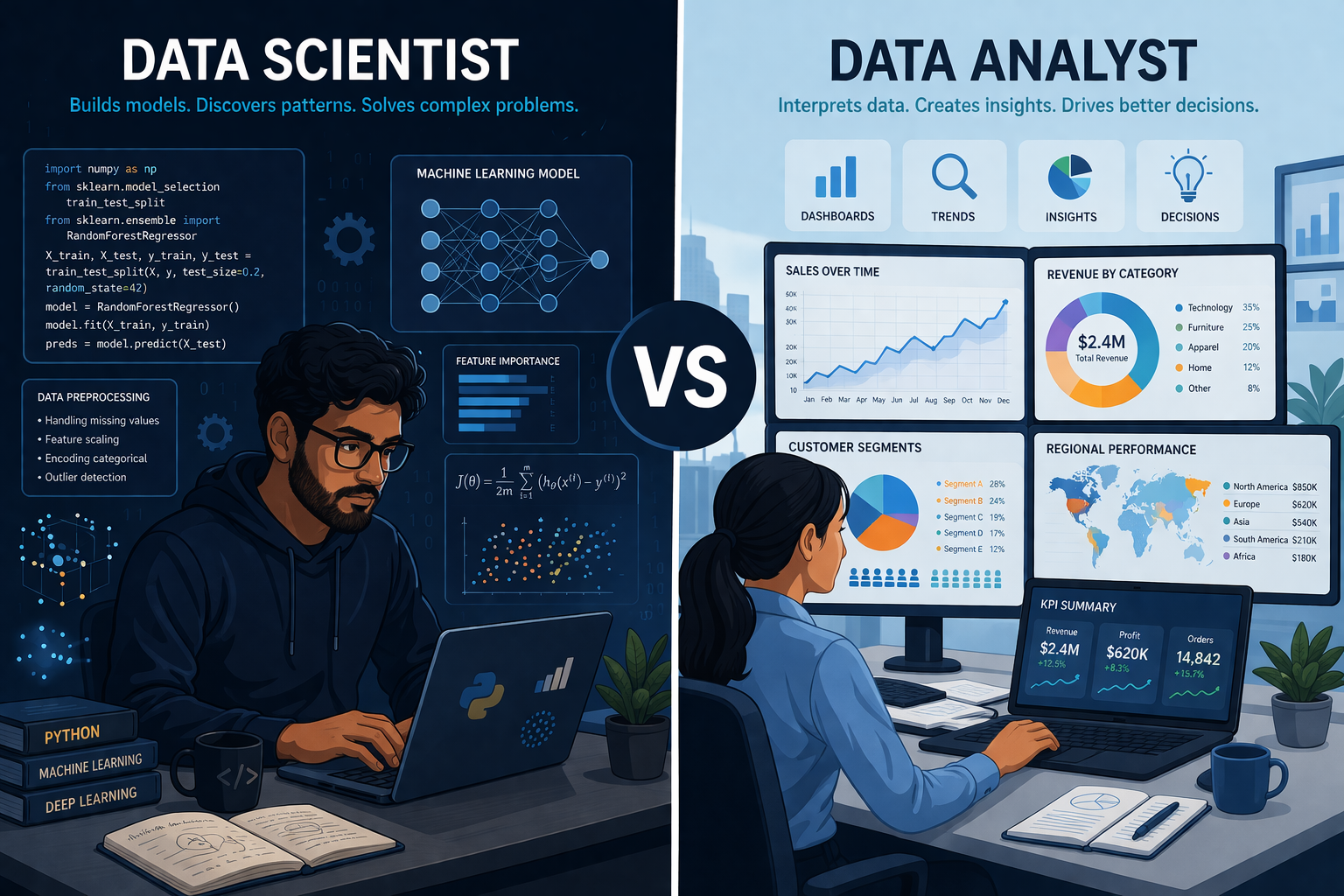
Once the data infrastructure is in place, data analytics comes into play. Data analysts focus on examining historical data to answer specific business questions. They create dashboards, reports, and visualisations that help decision-makers understand what is happening within the organisation.
For example, a retail company might use data analytics to track sales performance, customer behavior, and inventory levels. By analysing this data, analysts can identify trends, highlight areas of concern, and provide recommendations for improvement. Tools such as SQL, Excel, and business intelligence platforms are commonly used in this domain.
The key strength of data analytics lies in its ability to provide clarity and support decision-making. It answers questions like “What happened?” and “Why did it happen?” However, it is primarily focused on descriptive and diagnostic analysis, rather than predicting future outcomes.
This is where data science enters the picture. Data scientists build on the work of data analysts by using statistical models, machine learning algorithms, and advanced computational techniques to predict future trends and uncover hidden patterns in data.
For instance, a bank might use data science to predict which customers are likely to default on loans, or an e-commerce platform might use it to recommend products based on user behavior. Data scientists work with large datasets and complex models, often using programming languages such as Python or R.
Unlike data analytics, which focuses on understanding the past, data science is more concerned with the future. It answers questions like “What will happen?” and “What should we do about it?” This predictive capability makes data science a powerful tool for strategic decision-making.
Despite their differences, these three disciplines are deeply interconnected. A data scientist cannot build accurate models without high-quality data, which depends on data engineering. Similarly, data analysts rely on the infrastructure created by data engineers to access and analyse data efficiently.
In many organisations, collaboration between these roles is essential. Data engineers ensure that data is available and reliable. Data analysts interpret the data and communicate insights. Data scientists develop models that drive innovation and automation. Together, they form a cohesive data team that enables organisations to harness the full potential of their data.
However, the boundaries between these roles are not always rigid. In smaller organisations or startups, individuals may take on multiple responsibilities. A data analyst might perform basic data engineering tasks, or a data scientist might build data pipelines. As organisations grow, these roles tend to become more specialized.
One of the key challenges in building effective data teams is aligning these roles with business objectives. Organisations must ensure that their data strategy is not just technology-driven, but also focused on delivering value. This requires clear communication between technical teams and business stakeholders.
Another important consideration is the evolving nature of these fields. Advances in cloud computing, artificial intelligence, and automation are continuously reshaping the data landscape. Tools that simplify data engineering tasks, for example, are making it easier for analysts and scientists to access and work with data. Similarly, automated machine learning platforms are lowering the barrier to entry for data science.
For students and professionals, choosing between these career paths depends on their interests and strengths. Those who enjoy working with systems, infrastructure, and large-scale data processing may find data engineering more appealing. Individuals who prefer analysing data and creating visualisations may gravitate toward data analytics. Those with a strong interest in mathematics, statistics, and machine learning may be better suited for data science.
From an industry perspective, all three roles are in high demand. As organisations continue to invest in data-driven strategies, the need for skilled professionals in these areas is expected to grow. Companies are increasingly looking for individuals who not only possess technical expertise but also understand the business context in which data is used.