Edge AI vs Cloud AI: Which is Better?
Artificial Intelligence is now used in many industries such as healthcare, finance, manufacturing, retail, smart cities, and mobile applications. However, AI systems need computing power and data processing to work. This processing can happen either in the cloud or on edge devices. This is why the topic Edge AI vs Cloud AI has become very important in modern IT infrastructure and business technology decisions.
To understand the difference, we must first understand what Edge AI and Cloud AI mean. Cloud AI means that data is sent to remote cloud servers where AI models process the data and send the results back to the device. These cloud servers are powerful and can process very large amounts of data. Cloud AI is commonly used in applications like voice assistants, email filtering, recommendation systems, and business analytics.
Edge AI, on the other hand, means that AI processing happens directly on the device itself, such as a smartphone, IoT device, smart camera, drone, or industrial machine. The data does not need to be sent to the cloud because the AI model runs locally on the device. Edge AI is used in applications like facial recognition cameras, self-driving cars, smart home devices, and industrial automation systems.
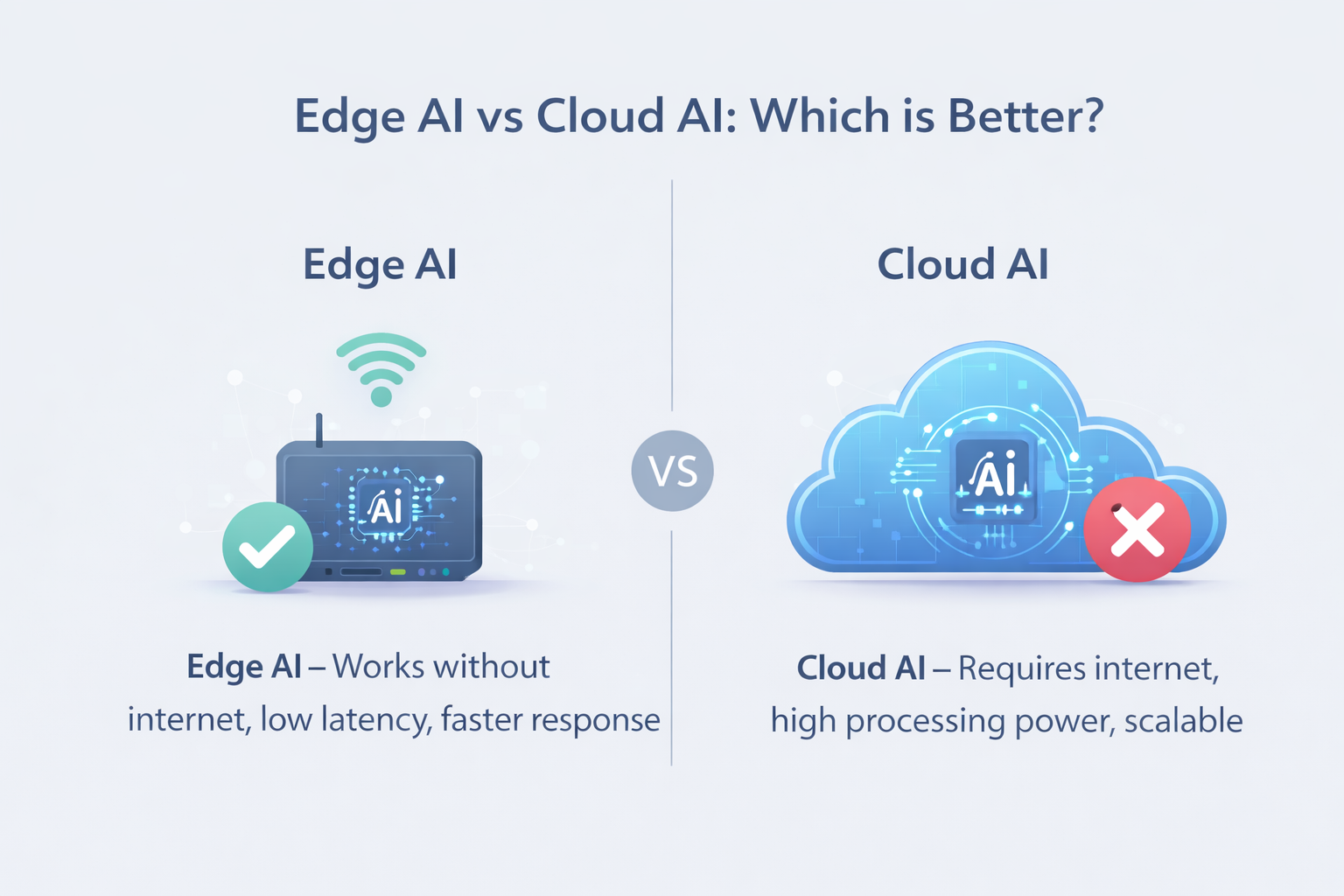
The main difference between Edge AI and Cloud AI is where the data processing happens. In Cloud AI, processing happens in remote data centers, while in Edge AI, processing happens on local devices.
One of the biggest advantages of Edge AI is low latency. Since data is processed on the device, the response time is very fast. This is very important in applications like autonomous vehicles, medical monitoring systems, and industrial robots where real-time decision-making is required. If these systems depend on cloud processing, there may be delays due to internet connectivity, which can be dangerous in critical situations.
Another advantage of Edge AI is better data privacy. Since data is processed locally, sensitive data does not need to be sent to the cloud. This reduces the risk of data breaches and improves privacy. This is important in healthcare devices, security systems, and personal devices.
Edge AI also works even when there is no internet connection. This makes it useful in remote areas, factories, and rural locations where internet connectivity is limited.
However, Edge AI also has some limitations. Edge devices have limited processing power, memory, and storage compared to cloud servers. This means very large AI models cannot run easily on edge devices. Edge AI systems can also be more expensive because each device needs hardware capable of running AI models.
Cloud AI, on the other hand, has very powerful computing resources. It can process large datasets and run complex AI models. Cloud AI is easier to update because the model is updated on the server, and all users get the updated version. Cloud AI is also more scalable because companies can increase or decrease computing resources based on demand.
But Cloud AI also has disadvantages. It requires internet connectivity, and there may be latency (delay) when sending data to the cloud and receiving results. Cloud AI also raises data privacy concerns because user data is stored and processed on remote servers.
In real-world applications, many companies use a combination of Edge AI and Cloud AI. This approach is called Hybrid AI. In hybrid AI, simple processing and real-time decisions are handled by Edge AI, while complex data analysis and model training are handled by Cloud AI. This combination provides both speed and high computing power.
For example, in a smart city traffic system, cameras use Edge AI to detect vehicles and traffic signals in real time, while Cloud AI analyzes traffic data from the entire city to improve traffic planning. In healthcare, wearable devices use Edge AI to monitor patient health in real time, while Cloud AI analyzes long-term health data to detect diseases.
So, which is better — Edge AI or Cloud AI? The answer depends on the application. If the application requires real-time processing, low latency, high privacy, and offline functionality, Edge AI is better. If the application requires large data processing, complex AI models, scalability, and centralized control, Cloud AI is better.
In the future, both Edge AI and Cloud AI will work together. With the development of 5G networks, IoT devices, and smart systems, Edge AI will become more common. At the same time, Cloud AI will continue to be important for big data processing and AI model training. Businesses will choose the combination of Edge AI and Cloud AI based on their needs.