
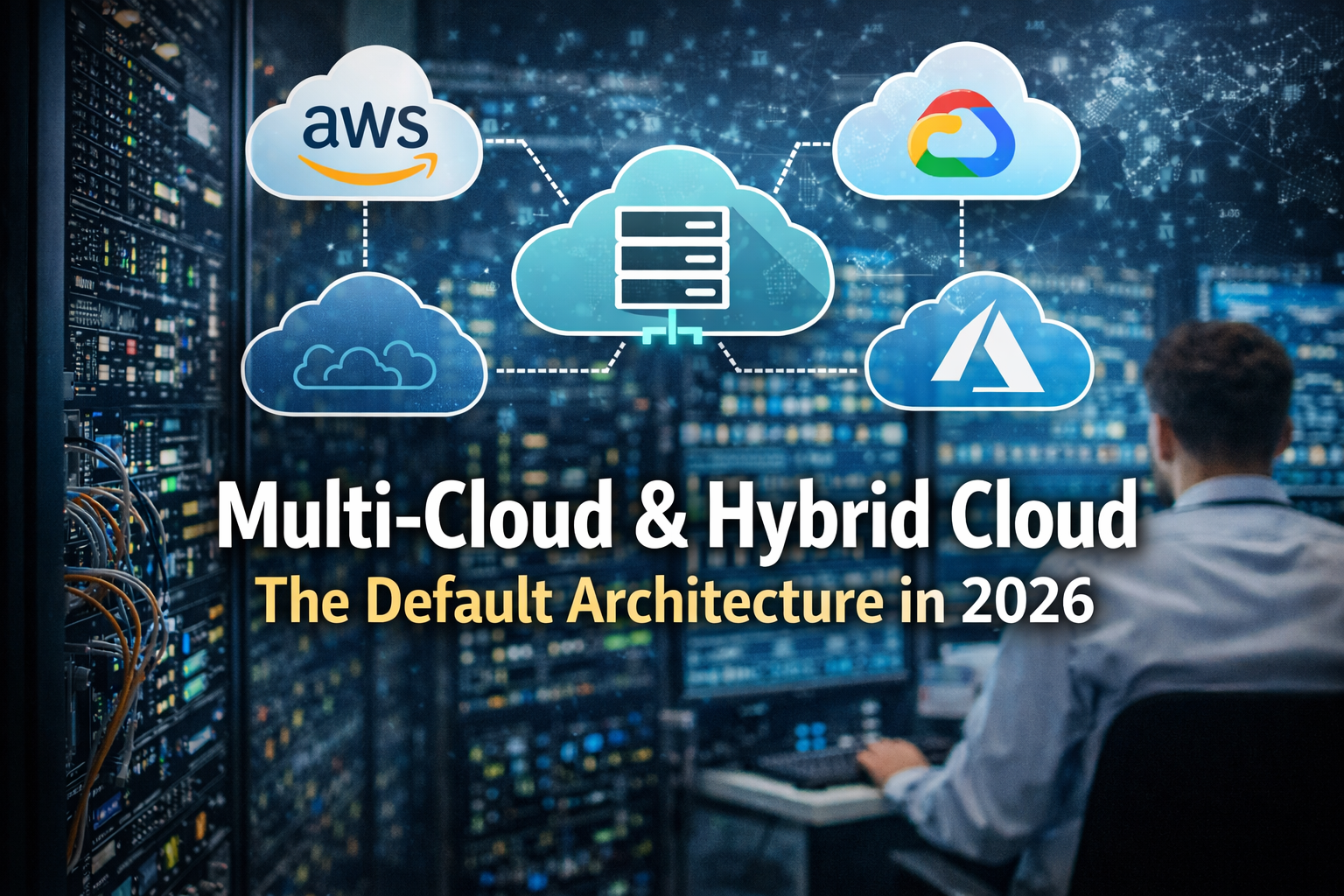
Multi-Cloud & Hybrid Cloud: The Default Architecture in 2026
A few years ago, businesses proudly said, “We’re on the cloud.”
In 2026, that statement feels incomplete. The real conversation now is:
“How many clouds are you running—and how well are they integrated?”
Welcome to the era where multi-cloud and hybrid cloud are no longer strategies—they’re the standard.
The Shift from Single Cloud to Multi-Cloud
Early cloud adoption was simple. Companies picked one provider, migrated workloads, and scaled from there.
But as businesses matured, so did their needs. Relying on a single cloud started to create limitations:
- Vendor lock-in
- Performance bottlenecks
- Limited flexibility
- Risk of outages
Today, organizations are choosing multi-cloud setups, using multiple providers for different workloads, and combining them with on-premise infrastructure—creating a hybrid cloud environment.
What is Multi-Cloud & Hybrid Cloud?
🔹 Multi-Cloud
Using multiple cloud providers (for example, one for storage, another for AI, another for analytics).
🔹 Hybrid Cloud
A mix of on-premise infrastructure + public/private cloud, allowing sensitive data or critical systems to stay in-house while leveraging cloud scalability.
Why This Became the Default in 2026
1. Flexibility is Everything
Different cloud providers excel at different things.
Businesses now choose:
- One cloud for AI workloads
- Another for cost-effective storage
- Another for global scalability
This “best-of-breed” approach gives companies maximum flexibility and performance.
2. Avoiding Vendor Lock-In
No company wants to be stuck with a single provider’s pricing, policies, or limitations.
Multi-cloud allows businesses to:
- Switch providers easily
- Negotiate better pricing
- Reduce dependency risk
3. Performance Optimization
Users expect speed—no matter where they are.
By distributing workloads across multiple clouds and regions, companies can:
- Reduce latency
- Improve uptime
- Deliver better user experiences
4. Data Sovereignty & Compliance
With stricter global regulations, businesses must control where their data lives.
Hybrid cloud helps:
- Store sensitive data locally
- Meet regulatory requirements
- Maintain control over critical systems
5. Rise of Edge Computing
With IoT, real-time analytics, and AI at the edge, data is no longer processed in one place.
Hybrid + multi-cloud enables:
- Real-time processing at the edge
- Centralized analytics in the cloud
- Seamless data flow between environments
Key Benefits for Businesses
🚀 Better Resilience
If one cloud provider goes down, workloads can shift to another—ensuring business continuity.
💰 Cost Optimization
Organizations can choose the most cost-effective provider for each workload.
⚡ Faster Innovation
Teams can use the best tools and services across different platforms without limitations.
🔐 Enhanced Security Control
Sensitive workloads can stay on-premise, while less critical operations run in the cloud.
Challenges to Manage
Let’s be honest—this isn’t simple.
⚠️ Complexity
Managing multiple platforms requires advanced skills and tools.
⚠️ Integration Issues
Ensuring smooth communication between different systems can be challenging.
⚠️ Security Risks
More environments mean more potential vulnerabilities if not managed properly.
⚠️ Cost Visibility
Without proper monitoring, multi-cloud costs can spiral quickly.
How Companies Are Solving This
To manage complexity, businesses are adopting:
- Cloud management platforms (CMPs)
- Unified dashboards for monitoring and cost tracking
- Automation tools for workload distribution
- AIOps for intelligent infrastructure management
The focus is shifting from just using multiple clouds to orchestrating them intelligently.
What’s Next?
Looking ahead, multi-cloud and hybrid cloud will evolve into:
- Fully automated cloud ecosystems
- AI-driven workload placement
- Seamless cross-cloud integration
- Greater focus on sustainability and efficiency
We’re moving toward a future where infrastructure decisions are made in real time by intelligent systems, not manual configurations.
In 2026, the question is no longer “Should we adopt cloud?”
It’s “How do we design a cloud strategy that gives us maximum flexibility, control, and performance?”
Multi-cloud and hybrid cloud architectures are the answer.
Businesses that embrace this model are not just reducing risk—they’re building resilient, scalable, and future-ready digital ecosystems.