
Multi-Cloud Is Dead—Welcome to AI-Orchestrated Cloud Ecosystems
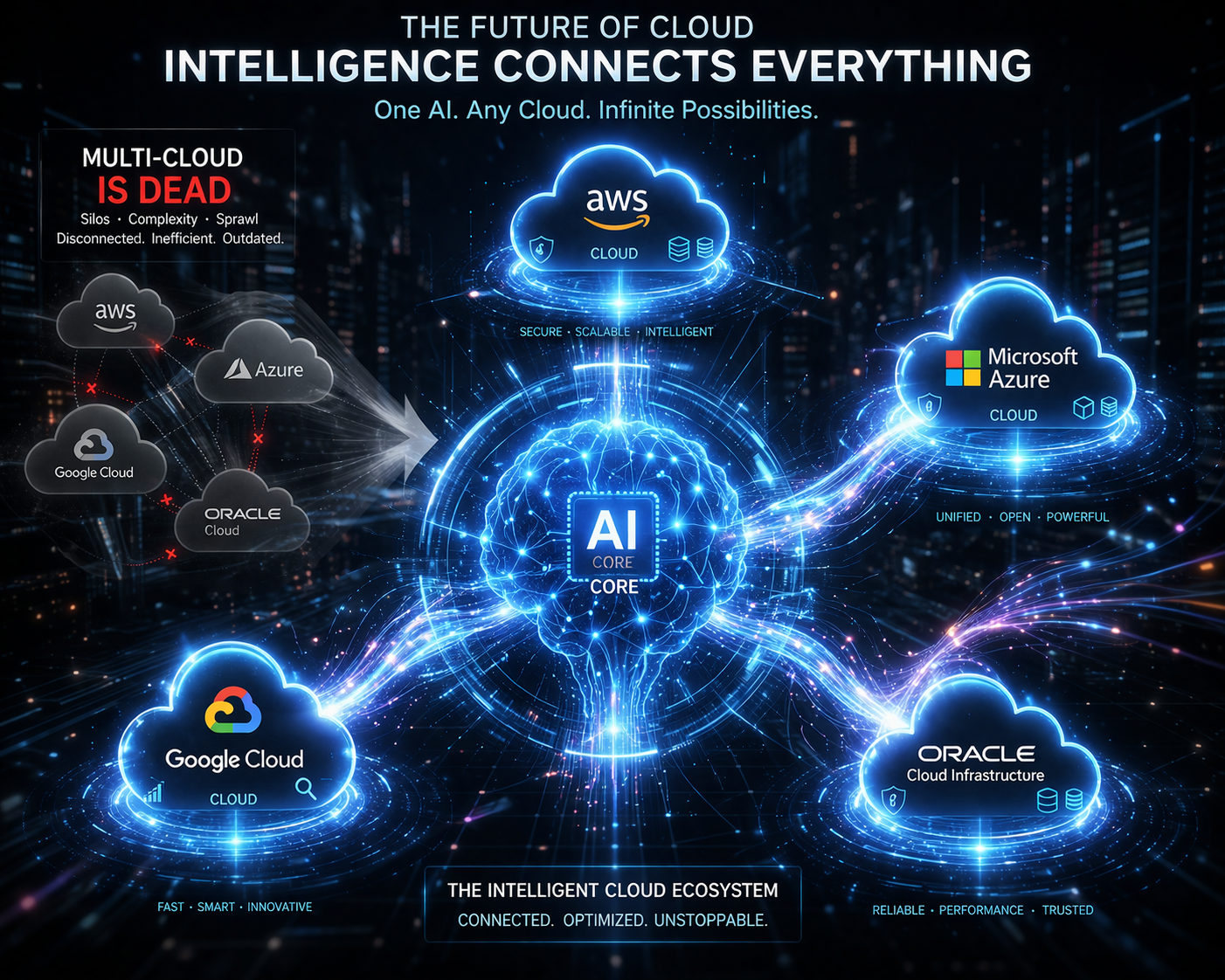
For years, “multi-cloud” was the answer to everything. Avoid vendor lock-in. Improve resilience. Optimize costs. Gain flexibility. Enterprises proudly declared their multi-cloud strategies, spreading workloads across platforms like Amazon Web Services, Microsoft Azure, and Google Cloud.
But beneath the surface, multi-cloud never quite delivered on its promise. It solved one problem—dependency—while quietly introducing others: complexity, inefficiency, and fragmented operations. Today, as artificial intelligence reshapes infrastructure at every level, the industry is moving beyond multi-cloud into something far more dynamic: AI-orchestrated cloud ecosystems.
This is not just a new architecture. It is a new way of thinking about computing.
The original idea behind multi-cloud was simple. Don’t rely on a single provider. Spread risk. Choose the best service for each use case. In theory, it sounded like freedom. In practice, it often turned into chaos.
Each cloud provider operates with its own tools, interfaces, pricing models, and architectural assumptions. Managing workloads across multiple environments required teams to duplicate effort, maintain parallel skill sets, and build complex integration layers. Instead of reducing friction, multi-cloud often multiplied it.
Data became fragmented. Governance became inconsistent. Costs became harder to predict. And perhaps most importantly, decision-making slowed down. Engineers spent more time managing infrastructure than building value.
Then AI entered the picture—and changed the rules.
Artificial intelligence doesn’t just run on infrastructure; it reshapes how infrastructure is used. Modern AI systems demand enormous compute power, real-time data access, and continuous optimization. Static deployment strategies—where workloads are manually assigned to specific clouds—can’t keep up with this level of complexity.
This is where AI orchestration comes in.
In an AI-orchestrated cloud ecosystem, workloads are no longer tied to a specific provider. Instead, they are dynamically allocated across environments based on real-time conditions. Performance, cost, latency, compliance, and availability are continuously evaluated by intelligent systems that decide where and how tasks should run.
The shift is subtle but profound. Instead of humans deciding, “This workload belongs on this cloud,” AI systems make that decision moment by moment.
It’s the difference between planning routes manually and using a GPS that adapts to traffic in real time.
This new model transforms the cloud from a set of destinations into a living, adaptive network. Compute becomes fluid. Data becomes mobile. Infrastructure becomes responsive.
Imagine an AI training workload that begins on one platform because it offers the lowest cost at that moment, then shifts to another because it provides faster GPUs, and finally distributes inference tasks to edge nodes closer to users. All of this happens automatically, without human intervention.
That is the essence of an AI-orchestrated ecosystem.
It also changes the role of cloud providers. Instead of being the central hub where everything runs, they become components within a larger system. Each provider contributes strengths—compute, storage, specialized hardware—but no single provider controls the entire workflow.
For enterprises, this reduces dependency in a more meaningful way than multi-cloud ever could. Not by splitting workloads manually, but by making infrastructure interchangeable at runtime.
One of the biggest advantages of AI orchestration is efficiency.
Traditional multi-cloud strategies often led to underutilized resources. Capacity was reserved “just in case,” leading to wasted spend. In contrast, AI systems continuously optimize usage. They allocate resources only when needed, scale dynamically, and shut down idle processes.
This is especially important in the age of AI, where compute costs can be enormous. Training large models, running inference at scale, and managing data pipelines require constant optimization. AI orchestration ensures that every unit of compute is used effectively.
But efficiency is only part of the story.
Resilience also improves dramatically. In a static multi-cloud setup, failover strategies are predefined and often limited. In an AI-orchestrated system, resilience is built into the fabric. If one environment experiences issues, workloads can shift instantly to another. The system adapts in real time, reducing downtime and improving reliability.
Security, too, takes on a new dimension. Instead of relying on perimeter-based defenses, AI-driven systems can monitor behavior across the entire ecosystem, detect anomalies, and respond dynamically. Threats are not just blocked—they are anticipated and mitigated as they evolve.
Of course, this transformation is not without challenges.
AI-orchestrated ecosystems introduce a new layer of complexity—one that must be carefully managed. Trust becomes a critical factor. Organizations need to understand how decisions are made, ensure transparency, and maintain control over sensitive data and processes.
There is also a shift in skills. Managing infrastructure manually is no longer enough. Teams must learn to design systems that can be managed by AI. This requires expertise in data, automation, and system architecture, as well as a willingness to rethink traditional approaches.
And then there is governance. When decisions are made dynamically, policies must be embedded into the system itself. Compliance, cost limits, and operational constraints need to be enforced automatically, not manually reviewed after the fact.
Despite these challenges, the direction is clear.
Multi-cloud, as it was originally conceived, is becoming obsolete. Not because using multiple clouds is no longer valuable, but because the way we manage them is changing. Static strategies are giving way to dynamic systems. Human-driven decisions are being augmented—and in some cases replaced—by intelligent orchestration.
The future is not about choosing between clouds. It is about letting the system choose for you.
In many ways, this shift mirrors broader trends in technology. Just as software moved from monolithic applications to microservices, and from on-premise servers to cloud platforms, infrastructure is now evolving into something more adaptive and autonomous.
AI is not just another layer on top of the cloud. It is becoming the control system that governs it.
And as this transformation unfolds, the winners will be those who embrace it early—who move beyond the limitations of multi-cloud and build systems designed for a world where infrastructure is no longer static, but alive.
The era of multi-cloud is ending.
The era of AI-orchestrated cloud ecosystems has begun.