The Death of Traditional ERP: AI Replacing Enterprise Systems
For decades, Enterprise Resource Planning (ERP) systems have been the backbone of modern organizations. From finance and supply chains to HR and procurement, ERPs promised a single source of truth—a centralized system to manage business operations efficiently. Companies invested millions implementing, customizing, and maintaining these systems, often treating them as the “brain” of the enterprise.
But today, that model is beginning to break.
Artificial intelligence is not just enhancing ERP systems—it is challenging their very existence. As AI evolves from a tool into an autonomous decision-making layer, the need for rigid, process-heavy enterprise systems is being called into question. What we are witnessing is not an upgrade cycle, but a paradigm shift: the gradual death of traditional ERP and the rise of AI-native enterprise operations.
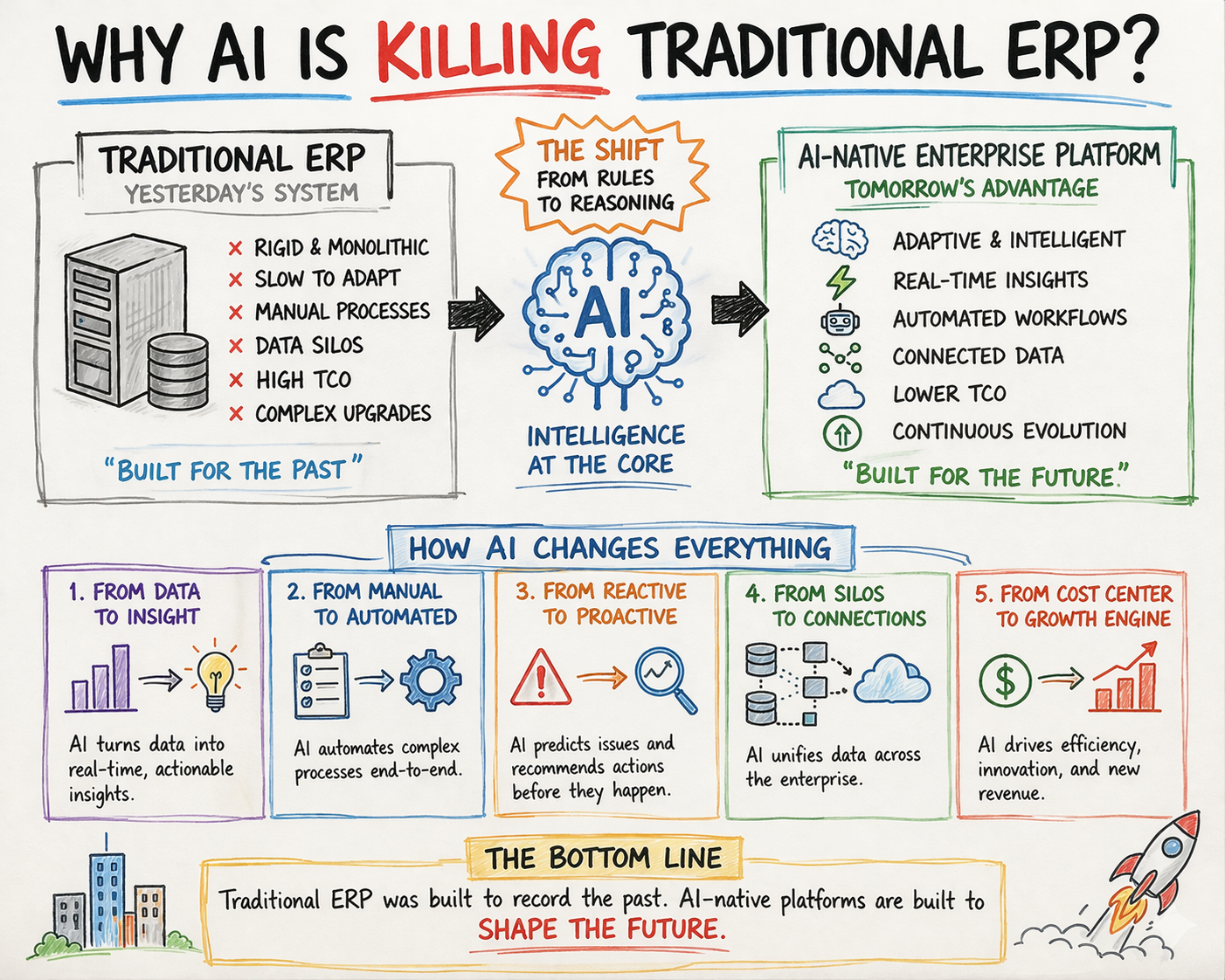
Traditional ERP systems were designed for a different era.
They emerged in a time when businesses needed to digitize paper-based processes and standardize operations across departments. The goal was control—ensuring that every transaction followed a predefined workflow, every data point was captured, and every process could be audited.
To achieve this, ERPs were built around structured data, fixed schemas, and rigid workflows. They required users to adapt to the system rather than the system adapting to the user. Over time, as businesses evolved, these systems became increasingly complex. Customizations piled up. Integrations multiplied. What started as a solution often became a constraint.
Anyone who has worked with an ERP knows the reality: slow interfaces, endless forms, and workflows that feel more like obstacles than enablers.
Enter AI.
Unlike traditional systems, AI does not rely on rigid rules or predefined workflows. It thrives on unstructured data, learns from patterns, and adapts dynamically. Instead of forcing users to input data into specific fields, AI can interpret natural language, analyze documents, and extract insights automatically.
This fundamentally changes how enterprise operations can be managed.
Imagine a finance function where invoices are processed without manual entry, discrepancies are flagged automatically, and payments are optimized in real time. Or a supply chain where demand is predicted continuously, inventory is adjusted dynamically, and disruptions are mitigated before they occur. Or HR systems where onboarding, performance tracking, and employee engagement are managed through intelligent agents rather than static workflows.
In these scenarios, the “system” is no longer a monolithic application. It is a network of AI agents performing tasks, making decisions, and coordinating actions.
This shift moves the enterprise from system-centric to intelligence-centric operations.
In a traditional ERP, the system is the source of truth. In an AI-driven model, truth is derived from data in real time. Instead of storing everything in a central database and enforcing consistency through rules, AI continuously reconciles information across sources, identifying discrepancies and updating insights dynamically.
This reduces the need for heavy data modeling and manual reconciliation—two of the most time-consuming aspects of ERP systems.
More importantly, it changes the user experience.
Instead of navigating complex interfaces, users interact with AI through natural language. They ask questions, give instructions, and receive insights instantly. The system becomes conversational, intuitive, and responsive.
The ERP screen is replaced by an intelligent assistant.
One of the most significant advantages of AI over traditional ERP is flexibility.
ERPs are notoriously difficult to change. Adding a new workflow or modifying an existing one often requires significant effort, including development, testing, and deployment. This makes it hard for organizations to adapt quickly to changing business conditions.
AI systems, on the other hand, can adapt continuously. They learn from new data, adjust their behavior, and evolve without requiring extensive reconfiguration. This allows organizations to be more agile, responding to market changes in real time.
It also enables a more personalized approach to operations. Instead of one-size-fits-all processes, AI can tailor workflows to specific contexts, users, or scenarios.
However, the transition from ERP to AI-native systems is not straightforward.
ERP systems are deeply embedded in organizations. They are not just tools—they are part of the operational fabric. Replacing them requires more than technology; it requires a fundamental rethinking of how work is done.
One of the biggest challenges is trust. ERP systems are valued for their reliability and auditability. They provide a clear record of transactions and decisions. AI systems, especially those based on machine learning, can be less transparent. Organizations need to ensure that AI-driven decisions are explainable, auditable, and compliant with regulations.
Another challenge is integration. Most organizations cannot simply abandon their existing ERP systems overnight. Instead, they must transition gradually, layering AI capabilities on top of existing infrastructure and replacing components over time.
This hybrid approach allows organizations to capture the benefits of AI while maintaining stability.
The role of humans also evolves in this new model.
In traditional ERP environments, employees spend a significant amount of time entering data, managing workflows, and resolving exceptions. AI automates much of this work, allowing humans to focus on higher-value activities such as analysis, strategy, and decision-making.
This shift not only improves efficiency but also enhances job satisfaction. Employees are no longer bogged down by repetitive tasks; they are empowered to contribute more meaningfully to the organization.
At the same time, new skills become essential. Understanding how to work with AI, interpret its outputs, and guide its behavior becomes a core competency.
From a strategic perspective, the decline of traditional ERP systems opens up new possibilities.
Organizations are no longer constrained by monolithic platforms. They can build modular, AI-driven architectures that are more flexible, scalable, and aligned with their specific needs. They can integrate data from multiple sources, leverage real-time insights, and continuously optimize their operations.
This also changes the competitive landscape.
Companies that adopt AI-native operations can move faster, make better decisions, and deliver superior customer experiences. They can operate with greater efficiency and lower costs. In contrast, organizations that remain tied to legacy ERP systems may struggle to keep up.
Yet, it is important to recognize that ERP is not disappearing overnight.
What we are seeing is an evolution rather than an abrupt replacement. ERP systems will continue to exist, but their role will diminish. They will become data repositories and compliance engines, while AI takes over as the operational layer.
In other words, ERP becomes the foundation, not the brain.
Looking ahead, the enterprise of the future will not be defined by a single system, but by a network of intelligent agents working together. These agents will handle everything from transactions and workflows to decision-making and optimization.
The result will be an organization that is more adaptive, more efficient, and more aligned with the needs of the modern world.
The death of traditional ERP is not the end of enterprise systems—it is the beginning of something far more powerful.
A shift from systems that manage work to systems that understand it.
And in that shift lies the future of the enterprise.